
A car stuck in mud can go from inconvenient to stressful in seconds. One heavy South Florida downpour, a soft shoulder near a work site, a muddy driveway, or an unpaved parking area can leave your tires spinning with no way forward. The right move is not to keep pressing the gas. Stop, assess the ground, and get professional recovery help before a simple stuck vehicle becomes damaged tires, a buried axle, or a dangerous roadside situation.
What to Do When Your Car Is Stuck in Mud
The first few minutes matter. Take your foot off the accelerator as soon as you feel the wheels losing traction. Spinning tires dig deeper, polish the mud into a slick surface, and can throw mud onto the underside of the vehicle. If the car is front-wheel drive, rear-wheel drive, or carrying a heavy load, the situation may worsen quickly.
Put the vehicle in park, set the parking brake, and turn on your hazard lights if you are near traffic. Check whether the vehicle is resting on its undercarriage or whether the tires alone are stuck. If the bottom of the car is sitting on mud, sand, or a hidden rut, do not try to force it out. More throttle can damage the bumper, exhaust, splash shields, suspension components, or transmission.
If you are on a public road, shoulder, canal-side route, construction entrance, or other exposed area, move yourself and passengers to a safe location away from traffic when possible. Avoid standing directly in front of or behind the vehicle while anyone attempts to move it.
Why Spinning Tires Makes a Mud Recovery Harder
Mud does not offer a stable surface for tires to grip. Every time the wheels spin, they scoop out more material beneath the tread. The vehicle sinks lower, the wheel wells fill, and the angle needed to pull the car free becomes more difficult.
Many drivers try shifting repeatedly between drive and reverse. Gentle rocking can sometimes help when a vehicle is only lightly stuck on level ground, but it is not a solution for deep mud. Rapid shifting can overheat the transmission, and hard acceleration can break traction completely. If the car does not move after one or two careful attempts, stop.
The same applies to placing random objects under the tires. Floor mats, cardboard, branches, and loose fabric may be pulled under the vehicle or thrown backward at speed. They rarely provide enough support for a heavy sedan, SUV, work truck, or loaded delivery vehicle. Do not use anything that could damage the vehicle, become a projectile, or leave you kneeling in an unsafe place.
When a Winch-Out Is the Safest Answer
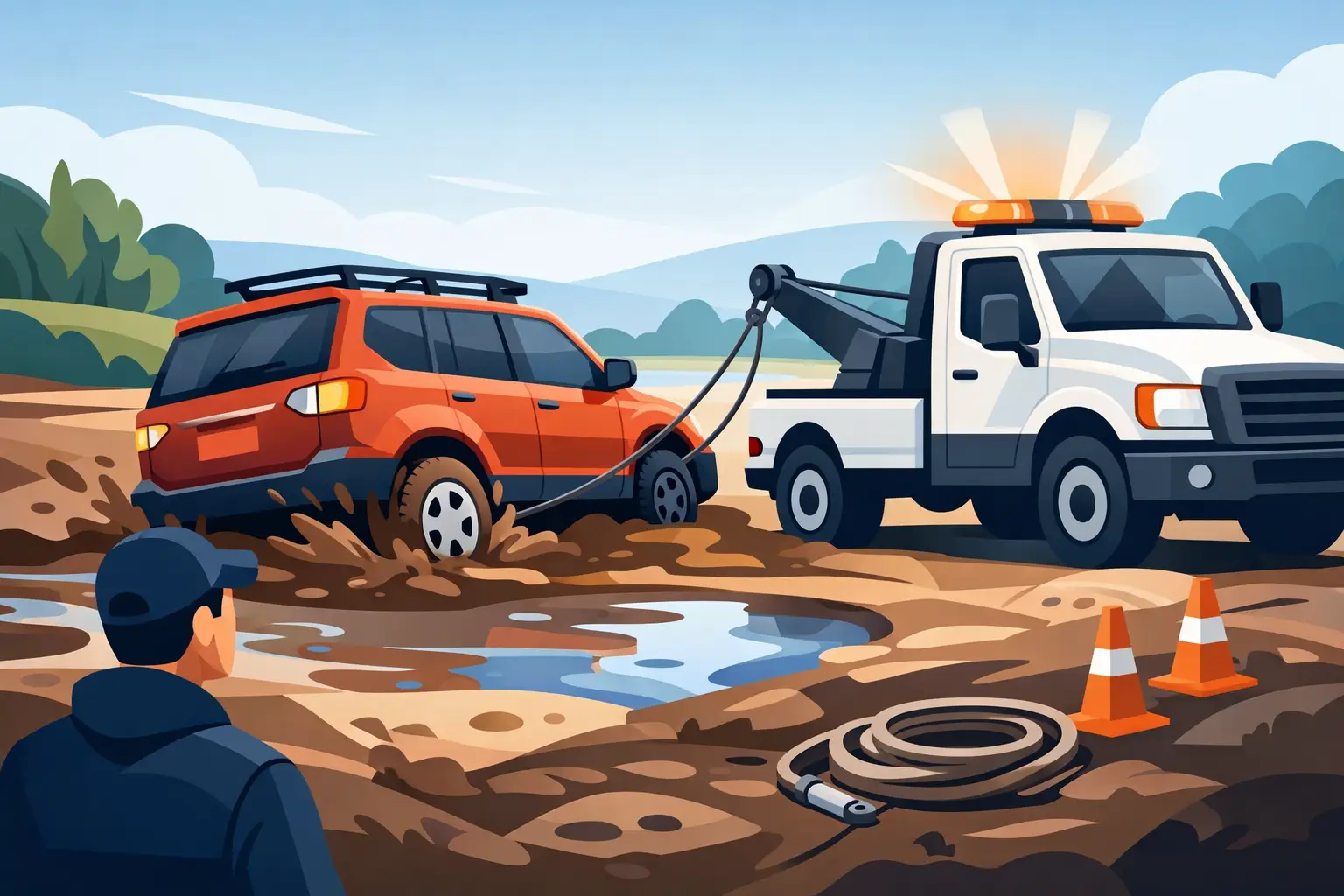
A professional winch-out is often the safest option when the car is sunken, the ground is saturated, or there is no solid path to drive out. Recovery technicians use appropriate equipment, controlled pulling angles, and proper attachment points to remove the vehicle with less risk of further damage.
Call for recovery help right away if the mud reaches the sidewall of the tires, the vehicle is leaning, the undercarriage is touching the ground, or one wheel has dropped into a ditch or rut. You should also call if the car is close to water, traffic, trees, fences, curbs, or another vehicle. These situations require more than a quick tug from a friend with a truck.
Not every tow point is a recovery point. Hooking a strap to a bumper, axle, suspension part, or unknown metal bracket can bend or break components. A snapped strap or chain can cause serious injury. A trained operator will inspect the vehicle and recovery area first, then choose the safest way to pull it free.
Stay Safe While You Wait for Help
Once you have requested assistance, conserve battery power and make the vehicle easy to locate. Keep hazard lights on if traffic conditions require them. If it is dark or raining heavily, use interior lighting only as needed and keep a safe distance from moving vehicles.
Do not let passengers stand in the recovery zone. During a winch-out, the operator needs clear space around the vehicle and a direct line for the recovery equipment. Follow instructions closely, especially if you are asked to steer, release the parking brake, or shift into neutral at a specific point.
If floodwater is involved, treat the situation differently. Do not attempt to drive through standing water just because another vehicle made it across. Water can hide deep holes, washouts, downed debris, and unstable ground. If water is rising around the vehicle, get to higher ground safely and call for emergency assistance as needed. Vehicle recovery should never put people at risk.
Common Places Cars Get Stuck in South Florida
South Florida drivers deal with a mix of wet ground, sandy soil, and sudden storms. A dry-looking shoulder can turn soft below the surface after rain. Grass parking areas at events, vacant lots, boat ramps, construction zones, and residential driveways can all become trouble spots.
In Miramar, Pembroke Pines, Weston, Hollywood, and Fort Lauderdale, afternoon rain can create muddy conditions with little warning. Delivery drivers, contractors, and fleet vehicles are especially vulnerable because they often pull into unfamiliar driveways, service areas, and unpaved entrances while working on a schedule.
Larger vehicles are not automatically safer. A pickup or commercial van may have more ground clearance, but added weight can cause it to sink deeper. All-wheel drive can improve traction, yet it cannot overcome a vehicle that is bottomed out or trapped in deep mud. The recovery method depends on the vehicle’s position, weight, available anchor points, and ground conditions.
How to Avoid Getting Stuck Again
Before pulling onto grass, dirt, or a soft shoulder, look for standing water, deep tire tracks, shiny mud, and areas where other vehicles have cut ruts. If the ground appears questionable, park on pavement and walk the remaining distance when practical. A few extra steps are easier than waiting for a recovery truck in the rain.
Keep basic emergency items in your vehicle, including a charged phone, flashlight, rain gear, and a reflective vest. For work vehicles and fleets, drivers should know who to call and what location details to provide. The most useful details are the nearest cross street, gate or entrance information, vehicle type, whether it is loaded, and whether the wheels or undercarriage are buried.
Do not assume a tow truck can reach every location without advance information. Narrow access roads, soft lawns, low branches, locked gates, and deep ditches can affect the equipment needed. Clear details help dispatch send the right recovery vehicle the first time.
Fast Recovery Help When You Need It
When your vehicle is stuck, you need a local team that understands the urgency and arrives prepared. ITow&Recovery provides 24/7 winch-out and vehicle recovery service for drivers across Broward County and surrounding South Florida communities. Whether your car slid into a muddy shoulder, your SUV is trapped in a wet lot, or a work truck cannot leave a job site, professional help can get the vehicle out safely and help you get moving again.
A car stuck in mud is not the time to gamble with hard acceleration, improvised straps, or a risky pull from another vehicle. Get to a safe spot, share your exact location, and let an experienced recovery operator handle the ground conditions and the vehicle with care.