
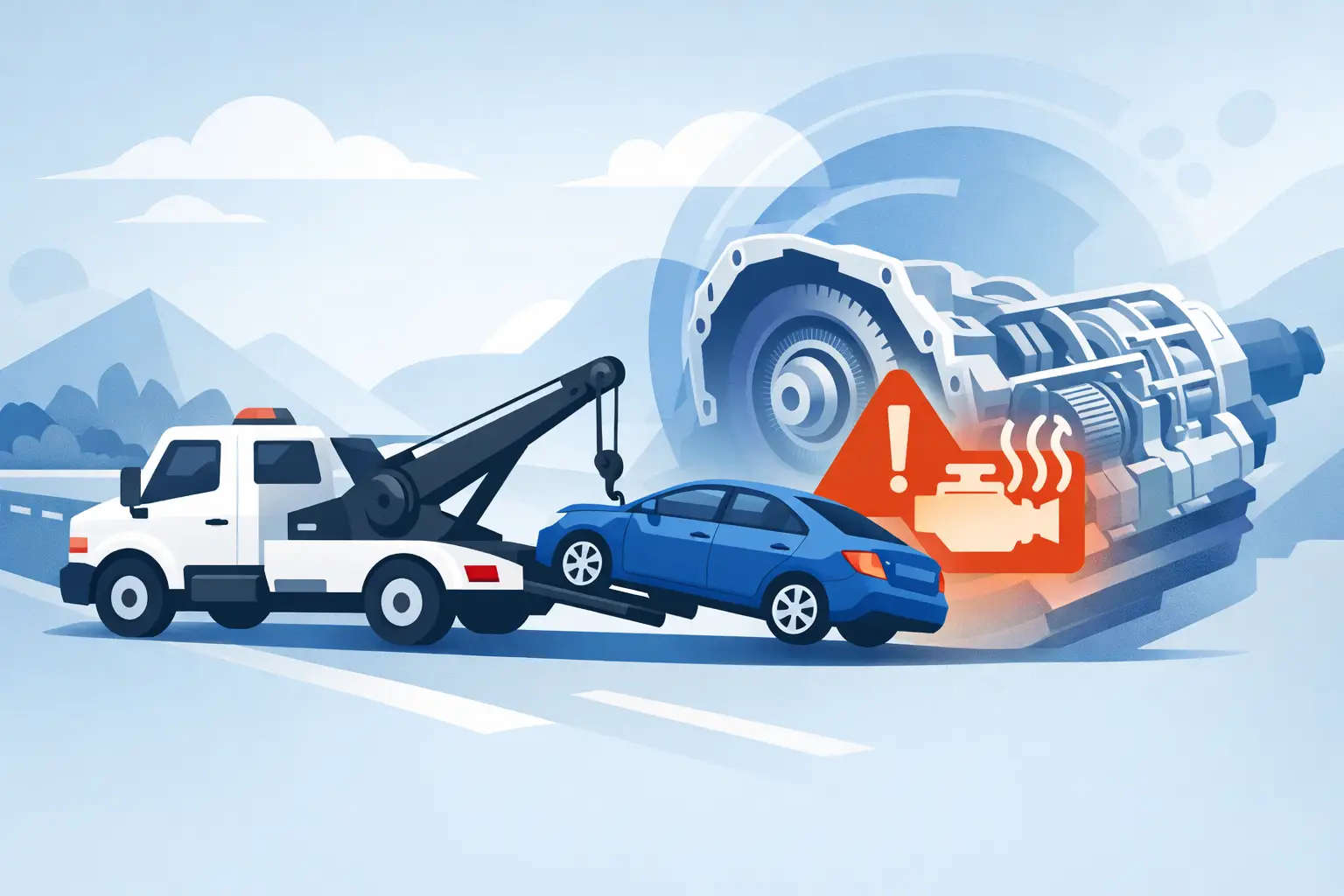
You see your car getting hooked up and one question hits fast: can towing damage transmission? The honest answer is yes – if the vehicle is towed the wrong way, with the wrong equipment, or without considering whether it is front-wheel drive, rear-wheel drive, all-wheel drive, or 4WD. The good news is that transmission damage is usually preventable when the tow is handled correctly from the start.
That matters even more during a stressful breakdown on I-75, a stalled commute through Fort Lauderdale, or a parking lot emergency in Miramar or Pembroke Pines. Most drivers are not thinking about drivetrains in that moment. They just want the car moved safely and the problem handled without turning one repair into two.
Can towing damage transmission on any vehicle?
It can, but the risk depends on how the vehicle is built and how it is being moved. Some vehicles can handle limited towing in specific situations. Others should only be moved on a flatbed. The transmission is at risk when the driven wheels stay on the ground and internal parts keep turning without proper lubrication.
Automatic transmissions are usually the biggest concern. In many vehicles, the transmission pump only works properly when the engine is running. If the car is being pulled with the drive wheels rolling on the road and the engine off, parts inside the transmission may move without enough fluid circulation. Heat and friction can build up fast.
Manual transmissions are sometimes a little more forgiving, but that does not mean they are safe in every towing setup. AWD and 4WD vehicles can be even more sensitive because power is distributed through more than one axle. If one set of wheels rolls while another stays fixed, you can stress the transmission, transfer case, or differential.
Why towing can damage a transmission
The issue is not towing by itself. The issue is improper towing.
When a vehicle is towed incorrectly, internal transmission components may rotate without the normal lubrication they rely on. That can wear clutch packs, bearings, and gears. On some models, even a short tow over the wrong distance can create problems. On others, damage might not show up immediately. A driver may get the car back, use it for a few days, and then notice slipping, delayed shifting, grinding, or warning lights.
Heat is another problem. Transmissions do not like excessive heat, and towing a vehicle with the wrong wheels on the ground can create exactly that. Add South Florida temperatures, stop-and-go traffic, and a heavy vehicle, and the risk goes up.
There is also the issue of tow speed and distance. A quick reposition in a parking lot is different from miles of road towing through Weston or Hollywood. The farther the tow, the more important the correct method becomes.
Which vehicles are most at risk?
Front-wheel-drive vehicles are at risk if they are towed with the front wheels on the ground. Rear-wheel-drive vehicles are at risk if the rear wheels stay down. AWD and many 4WD vehicles are usually the most restrictive because all four wheels may need to be off the ground.
Luxury vehicles, low-clearance cars, performance models, and newer vehicles with electronic transmission systems also deserve extra care. Some hybrid and electric vehicles have their own towing rules too. Assuming all cars can be towed the same way is where expensive mistakes happen.
That is why a professional tow starts with identifying the vehicle correctly, not just hooking it up and pulling away.
Flatbed vs wheel-lift: what is safer for the transmission?
If transmission protection is the goal, a flatbed is usually the safest choice. It keeps all four wheels off the road, which prevents drivetrain components from rotating during transport. For many modern vehicles, especially AWD, low-clearance, damaged, or unknown-condition vehicles, this is the preferred method.
Wheel-lift towing can still be safe in the right situation when the operator knows which wheels can stay down and whether dollies are needed. This method is common for shorter local moves and tight access areas. But it has to match the vehicle. If it does not, that is when transmission trouble becomes a real possibility.
This is where experience matters. A rushed or careless tow can create damage that did not exist before the truck arrived. A trained operator checks the drivetrain setup, vehicle condition, and manufacturer limits before moving anything.
Signs your transmission may have been damaged after towing
Sometimes damage is obvious right away. Sometimes it shows up after the stress of towing has had time to affect internal components. If your vehicle was recently towed and starts acting differently, pay attention.
Warning signs include delayed shifting, hard shifts, slipping between gears, transmission fluid leaking, burning smells, unusual noises, or a check engine or transmission warning light. You may also notice the vehicle hesitates when accelerating or does not go into gear smoothly.
None of those symptoms automatically prove the tow caused the issue. The vehicle may already have had a transmission problem before the breakdown. Still, if the trouble began right after towing, it is worth getting the vehicle inspected quickly before more damage develops.
How to reduce the risk before your car is towed
If your vehicle breaks down, ask what type of truck is being sent. If you drive an AWD, 4WD, luxury, exotic, lowered, hybrid, or electric vehicle, say that clearly when you call. Those details matter.
If you know whether your vehicle is front-wheel drive or rear-wheel drive, mention that too. If you do not know, give the year, make, and model so the dispatcher or operator can prepare properly. Good towing companies would rather ask a few extra questions than guess once they arrive.
It also helps to tell the tow operator why the vehicle stopped. If the transmission has already failed, the wheels are locked, or the car was in an accident, the loading plan may need to change. A vehicle that rolls freely is one thing. A disabled or damaged drivetrain is another.
Most important, do not let an unqualified person tow your car just because they can get there fast. Cheap, rushed towing often becomes expensive repair work.
Can towing damage transmission if the car is in neutral?
Sometimes drivers assume putting the vehicle in neutral solves the problem. It does not always. Neutral may allow the wheels to turn more freely, but it does not override the mechanical limits of the transmission or drivetrain design.
On many automatic vehicles, the lubrication issue is still there even in neutral. On AWD and 4WD systems, neutral may not protect the transfer case or related components the way drivers expect. That is why the correct answer is not based on guesswork or one rule for every car. It depends on the vehicle and the tow method.
What a professional tow company should do
A professional operator should identify the vehicle setup, choose the right towing equipment, secure the car at proper points, and avoid any method that puts the transmission at unnecessary risk. That means using a flatbed when needed, using dollies when appropriate, and not forcing a quick hookup that saves a few minutes but risks major damage.
For drivers in South Florida, this is not just a technical issue. It is a trust issue. When your car breaks down late at night in Hollywood, during rush hour in Fort Lauderdale, or outside work in Pembroke Pines, you need a towing team that knows how to move the vehicle safely the first time. That is the standard local drivers should expect.
ITow&Recovery handles these situations with the kind of practical care that matters on the roadside – fast dispatch, the right equipment, and attention to how the vehicle should actually be transported.
When you should insist on a flatbed
If your car is AWD, 4WD, low-clearance, heavily damaged, stuck, or showing transmission-related symptoms already, asking for a flatbed is usually the safest move. The same goes for long-distance transport or situations where you are not fully sure what drivetrain the vehicle has.
A flatbed may cost more in some cases, but that trade-off is minor compared to replacing or rebuilding a transmission. Saving a little on the tow is not worth risking thousands in repairs.
The safest approach is simple. Treat towing like part of the repair, not just transportation. If the vehicle is moved the wrong way, the tow itself can become the biggest mechanical problem you face.
When your car is stranded, ask questions, give accurate vehicle details, and choose a towing company that takes transmission safety seriously. A careful tow now can save you a major repair bill later.